

Meat vs. Silicon
The Difference Between Human and Artificial Intelligence
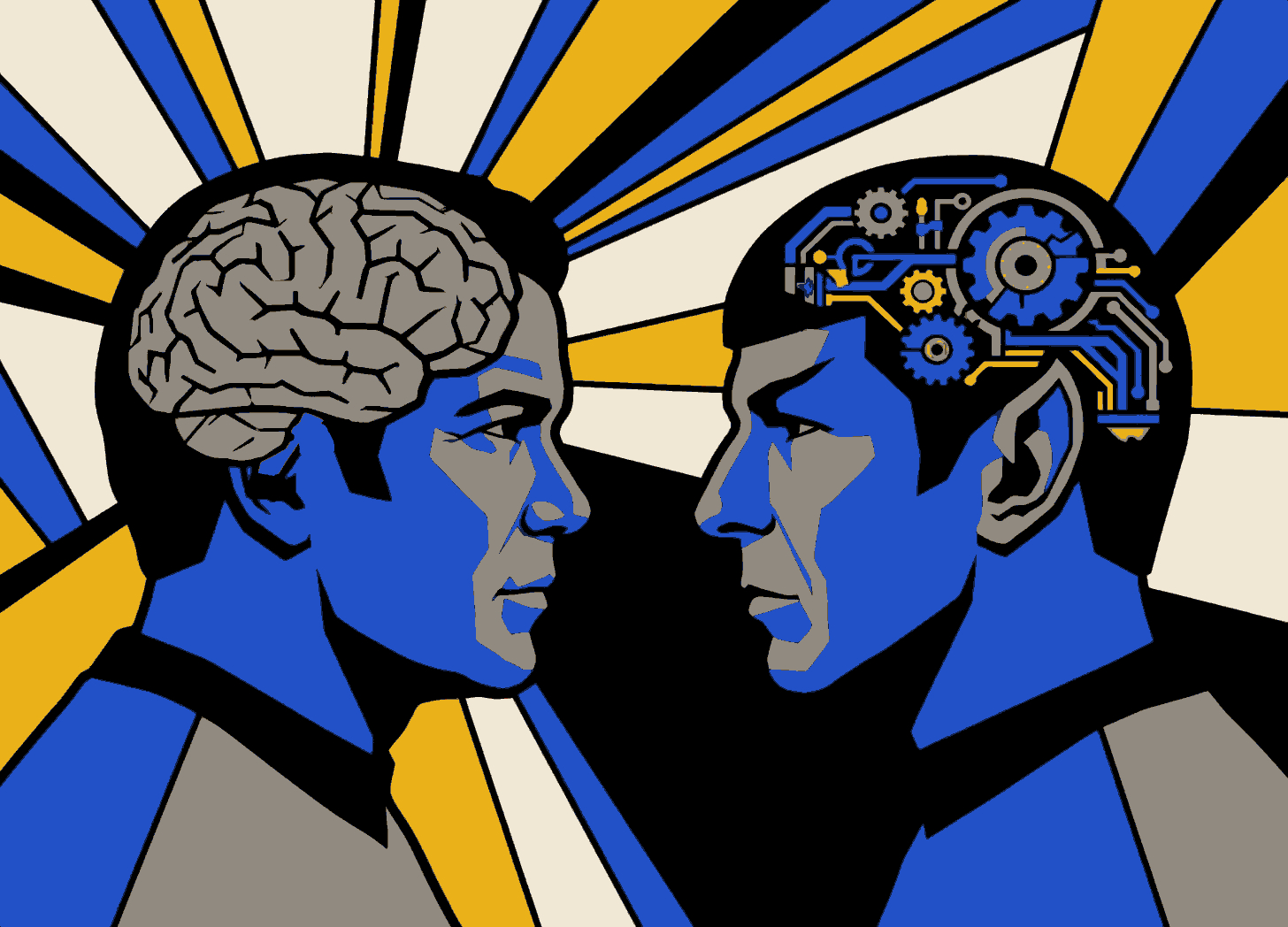
If you really want to understand the difference between artificial intelligence and the real thing, consider the power required to operate each.
The human brain, that soggy three-pound loaf sloshing around in your noggin, runs on about twenty watts of power, meaning that you can fuel it for an entire day with nothing but a Big Mac and a Slurpee. This gelatinous biological contraption can not only write poetry and solve differential equations, but it can also fall in love and feel guilt, all while sipping on just enough energy to power a Scooby-Doo nightlight.
The silicon computer, by contrast, is a literal dumpster fire. To approximate even a sliver of what the human brain does before breakfast, AI inference requires acres of data centers, megawatts of power, and industrial-scale cooling. Even when models are performing narrow, well-defined tasks, they do so with the efficiency of a bulldozer threading a needle.
Why such a disparity? One computer evolved through millions of years of trial, error, and predators. The other was made of sand we tricked into thinking.
And yet, three years after ChatGPT became a household name, the public is still asking the wrong questions. Is AI a miracle cure or the opening scene of a dystopian movie? Is it a panacea? Are we approaching the singularity? Should we be excited, terrified, or stockpiling truckloads of canned beans? The survivalists imagine a future machine that evaluates humans as inefficient legacy hardware. The optimists see a tool that executes instructions with blistering speed yet absolutely zero emotional attachment.
Those who read my work know that I’m a card-carrying member of the second camp. As a storyteller, and therefore a student of the human condition, I see the doomsayers’ folly as simple anthropomorphism: projecting agency onto a calculator.
Large Language Models (LLMs) predict outcomes based on patterns learned during training. Period. They’re a cascade of falling dominoes that ripple tokens through layers of weighted probabilities. Give them a poorly specified goal, and they’ll pursue it with terrifying efficiency, not because they want anything, but because they lack a fundamental meat computer ingredient: the human condition.
Just because an LLM can describe a cup of coffee doesn’t mean it knows how it tastes. No matter how many volumes of data an LLM ingests about hot caffeinated beverages, it’ll never know the difference between Starbucks, Peet’s, and Dunkin’ Donuts. And that’s just the sense of taste. Simply adding feelings of danger, love, or joy, and the tumblers fall into place to unlock the gate to Hallucination Land.
The space between human intelligence and artificial intelligence can be summed up in a single word: qualia.
Qualia are the subjective textures of existence: the sting of pain, the gnaw of regret, and that ever-present awareness of mortality. Human intelligence is inseparable from the body because mortality supplies the stakes, forcing the meat computer to process information differently from its silicon counterpart. In addition to logic, human reasoning is affected by hormones such as cortisol, adrenaline, dopamine, and oxytocin that bias, rush, mislead, and hijack our emotions. Since LLMs have never stubbed a toe or felt the heat of flushed cheeks, they have no experiential basis for understanding.
The relationship between real intelligence and artificial intelligence is best illustrated through two television show characters. For those too young or insufficiently nerdy to have seen Star Trek, we’re talking about Captain James T. Kirk, commander of the starship Enterprise, and his science officer, Mr. Spock.
Spock belongs to the Vulcan species, who suppress emotion in favor of pure logic. He has encyclopedic knowledge, flawless recall, and extraordinary computational ability. He can calculate survival odds to three decimal places and determine the most efficient path between any two points. What he can’t do is follow a hunch, understand a joke, or grasp why someone would knowingly risk rolling the dice. He operates entirely on data and probability, which makes him both brilliant and dangerous, because logic without context is just a pratfall away from catastrophe.
Captain Kirk is the opposite. He’s intuitive, emotional, and guided by the moral compass of responsibility. He bluffs when he’s losing, takes irrational risks when the odds are against him, and trusts his gut when the numbers say not to. Spock calculates the odds. Kirk decides whether or not to place the bet.
The future of AI depends on understanding the complementary roles of meat and silicon computers. Until a rack of NVIDIA GPUs can feel the anxiety of a missed deadline or the hollowness of heartbreak, artificial intelligence is precluded from human-level intelligence by definition. Machines can recommend, optimize, and speak with confidence. They can influence decisions, but can’t be responsible for them. When a cascade of falling dominoes knocks something over in the real world, “the model did it” isn’t an acceptable excuse.
That’s why we built Project OpenSARA. If a system can cause damage, we must measure the risk before flipping the switch. OpenSARA measures the likelihood of a failure, the magnitude of its downside, and how much autonomy we’re willing to live with.
If we’re going to let silicon computers place bets on our behalf, meat computers must own the screw-ups. OpenSARA gives them the House Rules to commit the wager without going all-in on a bad hand.